
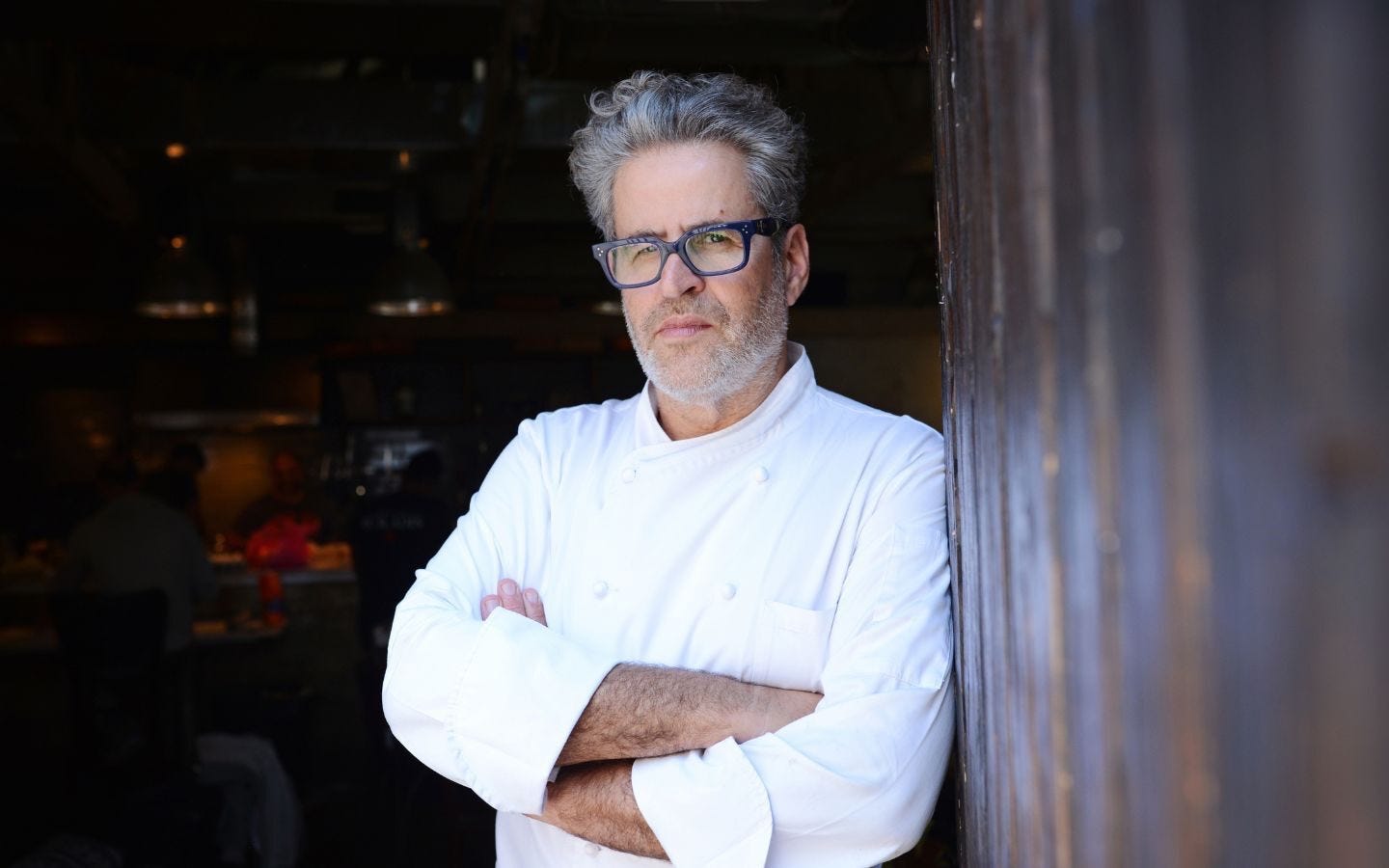
A Quickie with Eyal Shani
The Israeli chef behind HaSalon, Bella, and now Naked Tomato is still not counting
Eyal Shani doesn’t count his restaurants (”It’s like counting 65 children — how do I do that?”), can’t name a favorite city for food (”There is no one city”), and won’t even tell you which of his skewers to order (”I’m not treating you as a customer”). And he conducted his interview with an untouched baguette sitting in front of him.
So we probably should have seen it coming when we asked the Jerusalem-born chef, one of the people most responsible for putting Israeli cuisine on the global map, now on his third Miami concept with the just-opened Naked Tomato, why he chose Miami for a third time. He had a lot of feelings about that — and everything else.
Name: Eyal Shani
Nickname: It’s just my name, but pronounced the Jerusalem way. People from Tel Aviv and people from Jerusalem say it differently. It’s a small difference.
Title: Chef/Owner
Best childhood leftover memory: My refrigerator is completely naked, empty, to prevent leftovers. Jewish food, Israeli food, it’s all based on leftovers. You make something, and then you make another thing from it, and you can reach the tenth generation of the same dish. But me? I’m all about freshness, something done now. I have no memories of leftovers. I’m sorry to say.
My last meal would be: A good pita with falafel — one of the most genius dishes in the history of the culinary world. Or a good plate of hummus, the best bread, the best olive oil. Simple. Not complicated.
Why Miami? There’s a big move here. It’s the new “west” of the United States. People are looking for freedom in their personal lives, to get rid of cold places, to be optimistic and happy. And there is the culinary virginity of this place. It’s the beginning of the beginning. If you are working in New York, it’s all done there. It’s not under construction. Here, it’s the beginning of the construction. That is important for me.
What’s with the baguette? Someone put a baguette on the table and I stopped the meeting. I told my chef Victor: that is your enemy. Recognize your enemy. They call it a baguette, but it’s an elephant. You are here trying to make elegant food, and that is the shape of your enemy.
If you came in as a guest, what would you order? Our skewers. It’s made out of layers, thin layers, one above the other, and in between each layer, you can create different worlds. You can season it with this and with that. Each layer laying above another is a meeting point, and in this meeting point, you can create an entire world. We serve a fixed five. I’m not giving you an opportunity to choose.
What music is playing in your kitchen? Bach with Glenn Gould. That’s what I’ve been listening to for the last five years.
What do you wear at home in the kitchen? Naked! Or the best clothes I have, knowing it’ll be the last time they are clean. I have not one shirt without olive oil. Everything — splashes of tomatoes.
Go-to kitchen tool: A tablespoon. In the kitchen you have your cutting board, you have fire, and you have a knife, those are the three essential elements, all you need. But the tablespoon: with the knife you are changing shape, and with the tablespoon you are collecting it and removing it.
Favorite thing about the Miami restaurant scene: There was a Cuban restaurant, very simple, not trying to pretend, not putting a face in front of tourists. Serving something that really belongs to the local lives. When food is becoming authentic, it’s catching me. It doesn’t matter which kind of food. There’s no high and there’s no low. It’s authentic or not authentic. That is the essential thing I’m asking for.
What would people be most surprised to know about you? When I want to relax, I open Instagram and look at turtles. I look at their faces and get relaxed and feel so good. That is my meditation, turtles. I also have 15 of them at home.
Most overrated culinary trend? Fermentation. And making Japanese cuisine without truly understanding it. For Japanese people, to make an act with food is the reason for their being. Doing Japanese cuisine without becoming one with your blade and your fish — it’s not being Japanese.
If you weren’t a chef, what would you be? An architect. Or a violin player.
What advice would you give aspiring chefs? Be one with the thing that you’re doing. Don’t think what people would like, they’ll confuse you. Food is not a democracy. It’s a dictator scene. You are the only one deciding what is going to be. Cut all the outer noises.
Favorite city to visit for food? I cannot find one city that collects all my passions. There are a few things in Paris, a few things in Spain, some more in Italy. But maybe one place — the old city of Jerusalem, inside the walls. Two acres that, because of the unending war, weren’t changed. The best falafel, the best kebabs, the best seasonings ever. Maybe that is the only place where all my wishes are recognized.
Why is it called Naked Tomato? Two reasons. In Sicily, if someone important comes to visit you, the first act is to go to the garden, pick a tomato, and peel it for them. That is a sign that you are very important to me. The second reason: being naked means transparency. Most food is not naked, it’s made of layers masking other layers. I’m showing you what you got. There’s no secret behind it. Everything is exposed. And to make exposed food puts my kitchen in the most dangerous position — we cannot hide failures. Everything is exposed. That is the invitation.
Reserve at Naked Tomato here // 921 Washington Ave, Miami Beach (inside Moxy South Beach)


